
How Nervecept Works: Biological Mechanisms, Cellular Pathways & Trial Evidence
Nervecept's ingredients act on two broad pathways: connective tissue building blocks and inflammatory signaling. Here is how each is supposed to work, with an honest grade for the human evidence behind it.
First, how peripheral nerves get into trouble
Peripheral nerves are long cables that run from the spinal cord to the skin, muscles and organs. The longest ones reach the feet, which is why problems usually start in the toes. Each nerve contains large fibers that carry touch, vibration and position sense, and small fibers that carry pain and temperature. Many fibers are wrapped in myelin, an insulating sheath that speeds signals along.
Peripheral neuropathy is the umbrella term for damage to these nerves, and the National Institute of Neurological Disorders and Stroke lists more than 100 types[1]. In the most common form, distal symmetric polyneuropathy, damage starts at the farthest ends of the longest nerves and moves upward over months or years[2].
The usual causes
- Diabetes and prediabetes: the leading cause in the United States. High glucose damages the nerves and the tiny blood vessels that feed them[3][17].
- Vitamin B12 deficiency: more common with age, with metformin and after stomach surgery[16].
- Alcohol, chemotherapy and some other medicines.
- Thyroid and kidney disease, autoimmune conditions and inherited neuropathies.
- Compression: a pinched nerve in the back or a narrowed tunnel at the wrist can mimic neuropathy in one limb.
The reason this matters for a supplement buyer: the cause determines the treatment. Glucose control slows diabetic neuropathy; B12 shots or tablets can reverse deficiency neuropathy if caught in time; removing the trigger helps alcohol- and drug-related neuropathy. No capsule addresses those causes directly.
What the maker says Nervecept does
The Nervecept sales page makes five claims about how its ingredients "work synergistically": to enhance nerve health and eliminate pain and tingling; to protect nerves from "sticky toxins", reducing inflammation and promoting regeneration; to boost blood circulation to damaged nerves; to support long-term nerve protection; and to optimize regeneration of nerve cells for "a life free from neuropathy".
The label itself is more careful. It makes three structure-function claims, each with the required asterisk: "supports nerve sensitivity", "promotes nerve function" and "strength in extremities". Those are the claims the company is legally responsible for. The sales-page language goes well beyond them; "sticky toxins" is not a recognized medical mechanism, and no ingredient in the formula has been shown to regenerate nerve cells in humans.
The rest of this page sets out the mechanisms that are biologically plausible for the actual ingredients, with an honest grade for how much human evidence supports each one.
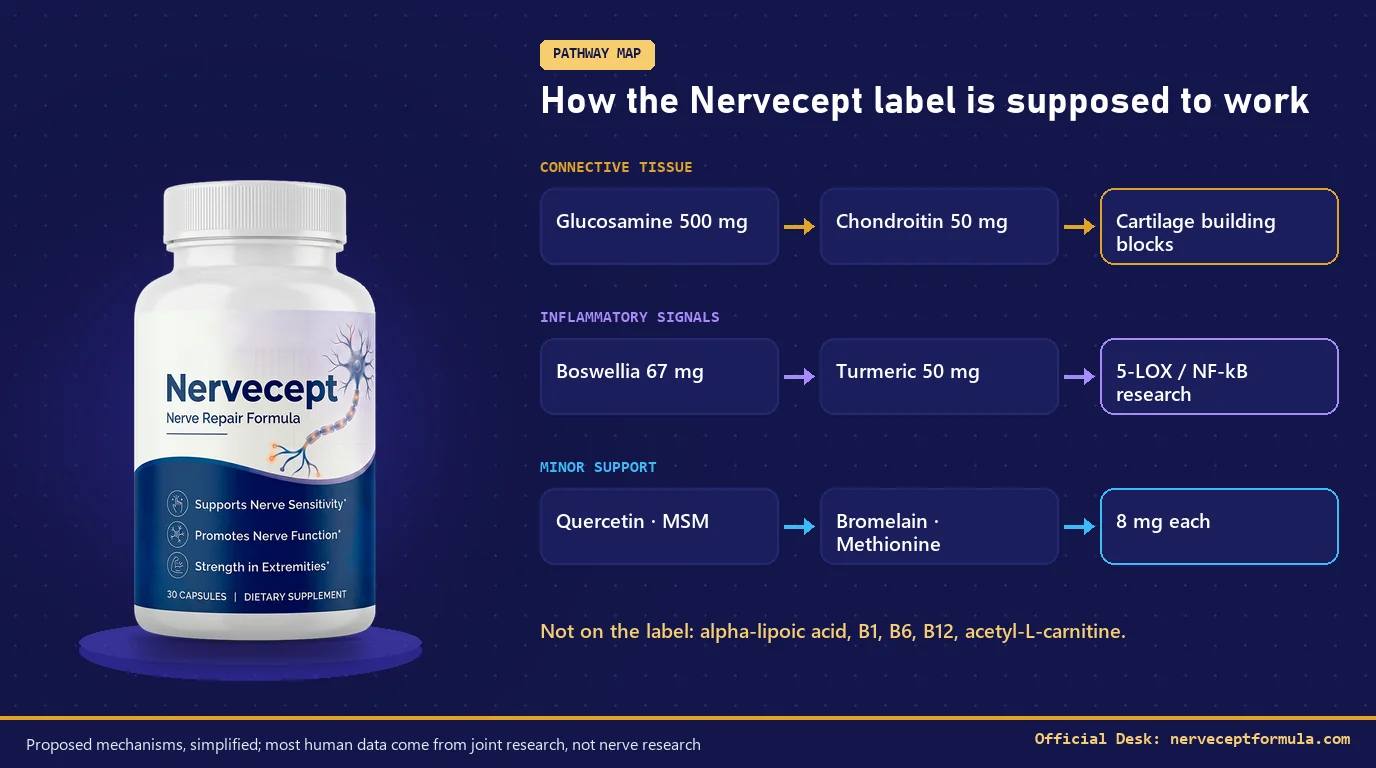
Pathway 1: connective tissue support (glucosamine, chondroitin, methionine, MSM)
Glucosamine and chondroitin are building blocks of glycosaminoglycans, and methionine and MSM supply sulfur, which is attached to those molecules to give them their water-holding charge. The proposed mechanism is straightforward: supply raw materials and the body uses some of them to maintain cartilage and the connective tissue around joints, tendons and, indirectly, nerves.
What the evidence says: in joints, results range from a modest structural benefit with 1,500 mg of crystalline glucosamine sulfate to no clinically relevant benefit in large trials[9]. Blood levels of glucosamine track the dose, and 500 mg yields much lower levels than 1,500 mg[10]. MSM's knee trials used grams, not milligrams[11]. No study has examined nerve outcomes.
Evidence grade for nerve symptoms: none. For joint comfort at the label dose: weak.
Pathway 2: calming inflammatory signals (boswellia, turmeric, quercetin, bromelain)
Inflammation participates in some neuropathic pain, and the four botanicals in Nervecept each act on inflammatory chemistry in laboratory models. Boswellic acids inhibit 5-lipoxygenase and so reduce leukotriene production[4]. Curcumin dampens NF-kB, a transcription factor that turns on many inflammatory genes. Quercetin has antioxidant and mast-cell-stabilizing activity[8]. Bromelain's enzymes are thought to reduce swelling by breaking down inflammatory proteins[12].
What the evidence says: standardized boswellia extracts at 100 to 250 mg improved knee osteoarthritis in a 90-day trial[5], and curcumin extracts around 1,000 mg a day reduced joint pain in pooled trials[7]. Curcumin's absorption is the main obstacle[6]. Nervecept's amounts are unstandardized and much smaller.
Evidence grade for nerve symptoms: theoretical. For joint comfort at the label dose: weak to very weak.
Pathway 3: circulation, the claim with the least support
The sales page says the formula boosts blood circulation to damaged nerves. Reduced blood flow in the tiny vessels around nerves is indeed part of how diabetes damages them. However, none of Nervecept's eight ingredients has human evidence of improving nerve blood flow at any dose, let alone at these amounts. Bromelain and turmeric have mild effects on platelets in laboratory studies, which is relevant mainly as a caution for people on blood thinners rather than as a benefit.
Evidence grade: none found.
How this compares with what nerve research actually tests
If you are choosing a supplement specifically for neuropathy symptoms, it helps to know where the human data are strongest.
| Approach | Typical dose | Human evidence for nerve symptoms | In Nervecept? |
|---|---|---|---|
| Alpha-lipoic acid | 600 mg/day | Symptom scores reduced in a meta-analysis and the oral SYDNEY 2 trial[13][14] | No |
| Vitamin B12 (if deficient) | Varies | Corrects deficiency neuropathy; little benefit if levels are normal | No |
| Glucose control | Not a supplement | Slows progression in type 1 diabetes; central in guidelines[15] | Not applicable |
| Approved medicines (pregabalin, duloxetine) | Prescribed | First-line for painful diabetic neuropathy in ADA guidance[15] | Not applicable |
| Glucosamine, chondroitin, boswellia, turmeric | Grams/day in trials | Joint studies only; no nerve trials | Yes, at lower doses |
This is why our assessment describes Nervecept as a comfort formula for the extremities rather than a nerve treatment. It may make sense for someone with mixed joint aches and mild foot discomfort; it is not built around the nerve research.
Does combining eight ingredients make up for low doses?
The theory behind multi-ingredient formulas is that several compounds acting on related pathways could add up to more than any one alone. In pharmacology, combinations do sometimes work that way. But synergy has to be shown, and it is usually shown at doses where each component is already active.
For Nervecept, three facts limit the synergy argument. Four ingredients are present at 8 mg, which is unlikely to be active under any model. Two of the remaining botanicals are unstandardized, so their active compounds are unknown. And no published study has tested this combination. The honest description is "plausible but untested", which is also what NCCIH advises consumers to keep in mind for most supplement combinations[18].
What a realistic response looks like
If the formula helps you, the most likely pattern is a gradual, modest easing of aching or stiffness over four to eight weeks, often first noticed when walking or getting up in the morning. Burning, electric pain and numbness are less likely to change, because they come from damaged nerve fibers that these ingredients have not been shown to affect.
The best way to know is a simple log. Score your main symptom from 0 to 10 every evening, note your sleep, and compare weekly averages at weeks one and six. A change of two points or more on average is the kind of difference people notice in daily life. Our results timeline and how-to-use guide walk through it.
Questions on this topic
Does Nervecept regenerate nerves?
No study shows that. None of its eight ingredients has human evidence of nerve regeneration at any dose. The label's own claims are limited to supporting nerve sensitivity and function.
How quickly does Nervecept start working?
The trials of its main ingredients measured changes after 8 to 24 weeks. Expect weeks, not days, and plan to judge it at around six weeks so you can still use the 60-day refund window.
Why does a nerve formula use joint ingredients?
The maker positions comfort in the hands and feet as nerve support. The ingredients themselves come from osteoarthritis research, which is the best-documented use for glucosamine, chondroitin, boswellia and turmeric.
Is inflammation the cause of my neuropathy?
Sometimes it contributes, but the main drivers are usually high blood sugar, low B12, alcohol, medicines or compression. A doctor can test for the common causes.
Can Nervecept replace my nerve-pain medicine?
No. It is a dietary supplement. Do not stop or reduce gabapentin, pregabalin, duloxetine or any prescribed drug without talking to your prescriber.
Sources for this page
Each entry links to the original record. These studies test single ingredients, usually at higher doses; none tested the finished Nervecept capsule.
- 1National Institute of Neurological Disorders and Stroke. Peripheral Neuropathy. www.ninds.nih.gov/health-information/disorders/peripheral-neuropathy
- 2Callaghan BC, Price RS, Feldman EL. Distal symmetric polyneuropathy: a review. JAMA. 2015;314(20):2172-2181. pubmed.ncbi.nlm.nih.gov/26599185/
- 3Feldman EL, Callaghan BC, Pop-Busui R, et al. Diabetic neuropathy. Nat Rev Dis Primers. 2019;5(1):41. pubmed.ncbi.nlm.nih.gov/31197153/
- 4Siddiqui MZ. Boswellia serrata, a potential antiinflammatory agent: an overview. Indian J Pharm Sci. 2011;73(3):255-261. pubmed.ncbi.nlm.nih.gov/22457547/
- 5Sengupta K, Alluri KV, Satish AR, et al. A double blind, randomized, placebo controlled study of the efficacy and safety of 5-Loxin for treatment of osteoarthritis of the knee. Arthritis Res Ther. 2008;10(4):R85. pubmed.ncbi.nlm.nih.gov/18667054/
- 6Anand P, Kunnumakkara AB, Newman RA, Aggarwal BB. Bioavailability of curcumin: problems and promises. Mol Pharm. 2007;4(6):807-818. pubmed.ncbi.nlm.nih.gov/17999464/
- 7Daily JW, Yang M, Park S. Efficacy of turmeric extracts and curcumin for alleviating the symptoms of joint arthritis: a systematic review and meta-analysis of randomized clinical trials. J Med Food. 2016;19(8):717-729. pubmed.ncbi.nlm.nih.gov/27533649/
- 8Li Y, Yao J, Han C, et al. Quercetin, inflammation and immunity. Nutrients. 2016;8(3):167. pubmed.ncbi.nlm.nih.gov/26999194/
- 9Clegg DO, Reda DJ, Harris CL, et al. Glucosamine, chondroitin sulfate, and the two in combination for painful knee osteoarthritis. N Engl J Med. 2006;354(8):795-808. pubmed.ncbi.nlm.nih.gov/16495392/
- 10Persiani S, Roda E, Rovati LC, et al. Glucosamine oral bioavailability and plasma pharmacokinetics after increasing doses of crystalline glucosamine sulfate in man. Osteoarthritis Cartilage. 2005;13(12):1041-1049. pubmed.ncbi.nlm.nih.gov/16168682/
- 11Kim LS, Axelrod LJ, Howard P, Buratovich N, Waters RF. Efficacy of methylsulfonylmethane (MSM) in osteoarthritis pain of the knee: a pilot clinical trial. Osteoarthritis Cartilage. 2006;14(3):286-294. pubmed.ncbi.nlm.nih.gov/16309928/
- 12Brien S, Lewith G, Walker A, Hicks SM, Middleton D. Bromelain as a treatment for osteoarthritis: a review of clinical studies. Evid Based Complement Alternat Med. 2004;1(3):251-257. pubmed.ncbi.nlm.nih.gov/15841258/
- 13Ziegler D, Nowak H, Kempler P, Vargha P, Low PA. Treatment of symptomatic diabetic polyneuropathy with the antioxidant alpha-lipoic acid: a meta-analysis. Diabet Med. 2004;21(2):114-121. pubmed.ncbi.nlm.nih.gov/14984445/
- 14Ziegler D, Ametov A, Barinov A, et al. Oral treatment with alpha-lipoic acid improves symptomatic diabetic polyneuropathy: the SYDNEY 2 trial. Diabetes Care. 2006;29(11):2365-2370. pubmed.ncbi.nlm.nih.gov/17065669/
- 15Pop-Busui R, Boulton AJ, Feldman EL, et al. Diabetic neuropathy: a position statement by the American Diabetes Association. Diabetes Care. 2017;40(1):136-154. pubmed.ncbi.nlm.nih.gov/27999003/
- 16de Jager J, Kooy A, Lehert P, et al. Long term treatment with metformin in patients with type 2 diabetes and risk of vitamin B-12 deficiency: randomised placebo controlled trial. BMJ. 2010;340:c2181. pubmed.ncbi.nlm.nih.gov/20488910/
- 17National Institute of Diabetes and Digestive and Kidney Diseases. Diabetic Neuropathy. www.niddk.nih.gov/health-information/diabetes/overview/preventing-problems/nerve-damage-diabetic-neuropathies
- 18National Center for Complementary and Integrative Health. Using Dietary Supplements Wisely. www.nccih.nih.gov/health/using-dietary-supplements-wisely
Ready to give Nervecept a fair 60 days?
Orders complete on the maker's BuyGoods checkout. The refund policy covers opened and empty bottles if you email support within the 60-day window.