
Official Nervecept Supplement Facts: Label Transcript, Milligrams & Testing
A line-by-line transcript of the Nervecept panel, what each entry means, how the amounts compare with research doses, and what testing the label does and does not tell you.
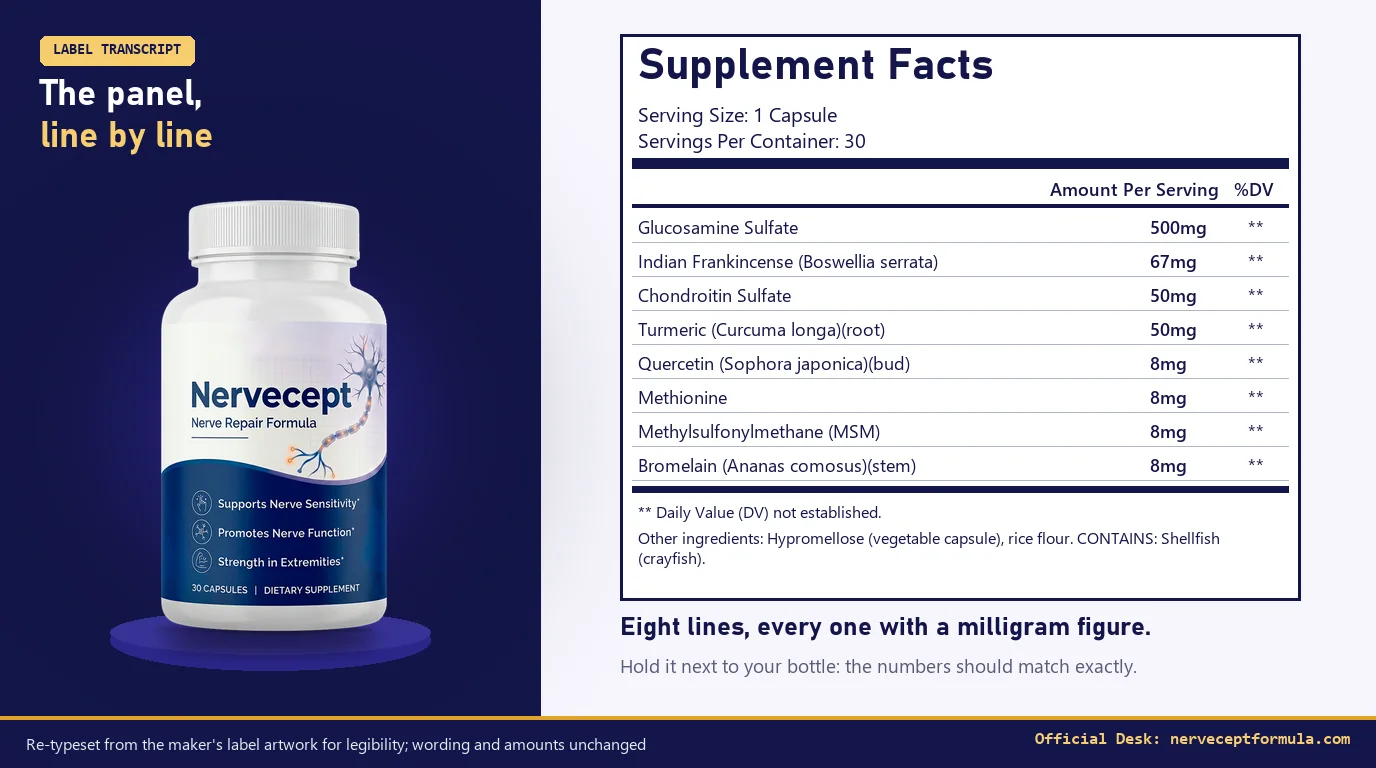
The panel, transcribed
Supplement Facts
Servings Per Container: 30
OTHER INGREDIENTS: Hypromellose (Vegetable Capsule), Rice Flour. CONTAINS: Shellfish (Crayfish).
This transcript reproduces the panel on the maker's label artwork, checked line by line on October 16, 2026. Capitalization is simplified; names, amounts and the allergen statement are unchanged. If the bottle you receive shows different numbers, the bottle in your hand is the legal label, and we would like to hear about the difference at [email protected].
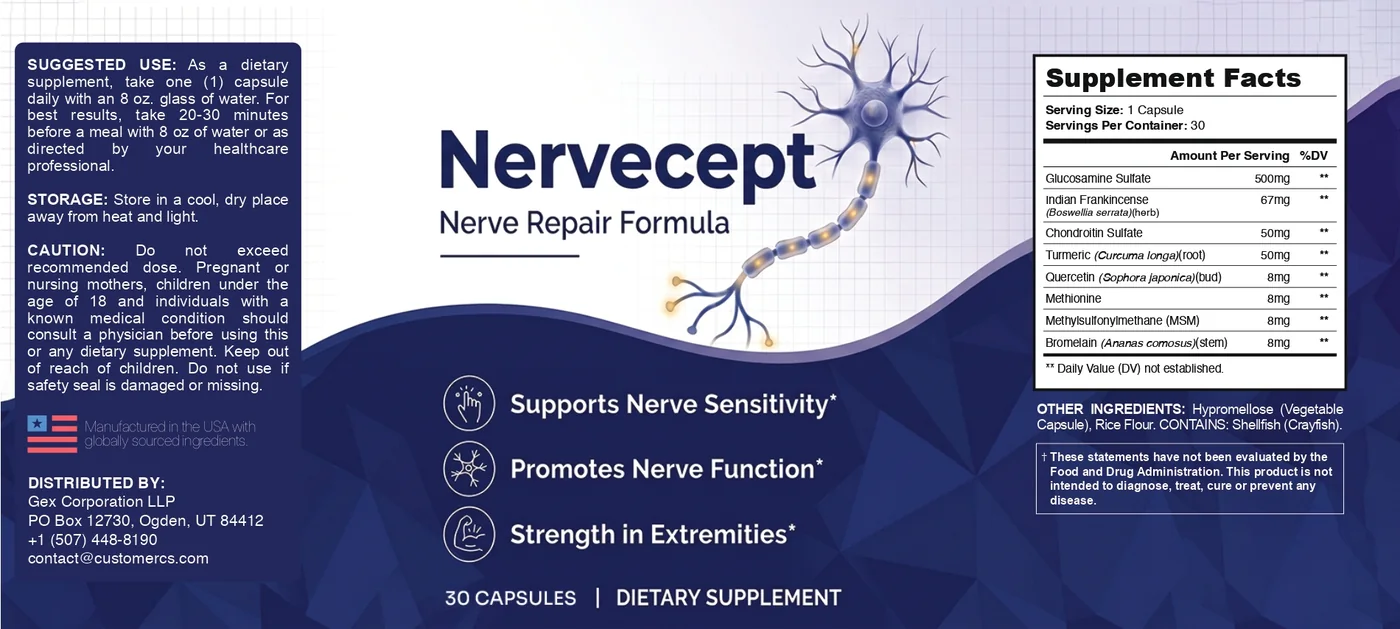
Reading each line
Serving size and servings per container
One capsule is one serving, and there are 30 per bottle. With the label's directions of one capsule daily, a bottle lasts exactly 30 days, which makes cost per day easy to calculate: the price of a bottle divided by 30.
Amount per serving
Each line gives the weight of the ingredient in milligrams per capsule. The total of the eight lines is 699 mg. Because every ingredient has its own amount, this is a fully disclosed formula; there is no proprietary blend hiding individual amounts behind one combined weight.
The %DV column and the double asterisks
Percent Daily Value exists only for nutrients with an official reference intake, such as vitamins and minerals. None of Nervecept's ingredients has one, so the column shows "**" with the footnote "Daily Value (DV) not established". That is normal for botanical and specialty ingredients and is not a sign of anything missing.
Plant parts in brackets
The words "(herb)", "(root)", "(bud)" and "(stem)" identify the part of the plant used. U.S. labeling rules require the plant part for botanical ingredients. What the label does not give is an extract ratio or a standardization percentage, which suggests these are powders of the plant material rather than concentrated extracts.
Other ingredients
Hypromellose is the vegetable cellulose that forms the capsule shell. Rice flour is a filler and flow agent. There are no listed colors, sweeteners or preservatives.
Allergen statement
"Contains: Shellfish (Crayfish)" is the declaration required for crustacean shellfish, one of the major food allergens under U.S. law[3]. It refers to the glucosamine source. Research suggests reactions to glucosamine in shellfish-allergic people are uncommon[4], but the label gives no exception, and neither do we.
Suggested use, storage and cautions on the bottle
| Label section | What it says (in substance) | What it means for you |
|---|---|---|
| Suggested use | One capsule daily with an 8 oz glass of water; for best results 20 to 30 minutes before a meal, or as directed by a healthcare professional | Pick a meal you never skip and take it before that meal every day |
| Storage | Store in a cool, dry place away from heat and light | Not in the bathroom cabinet or a hot car; a kitchen cupboard away from the stove is fine |
| Caution: dose | Do not exceed recommended dose | One capsule is the daily maximum on the label |
| Caution: groups | Pregnant or nursing mothers, children under 18 and individuals with a known medical condition should consult a physician first | Includes anyone being treated for diabetes, bleeding disorders, kidney or liver disease |
| Caution: seal | Do not use if safety seal is damaged or missing | Check before opening; contact support with your order ID if it is broken |
| Origin | Manufactured in the USA with globally sourced ingredients | Made domestically; raw materials may come from abroad, which is common |
| Distributor | Gex Corporation LLP, PO Box 12730, Ogden, UT 84412, +1 (507) 448-8190, [email protected] | The company responsible for the product in the U.S. market |
The front panel adds three claims, each with an asterisk linking to the FDA disclaimer: "Supports Nerve Sensitivity", "Promotes Nerve Function" and "Strength in Extremities".
How the printed amounts compare with studied amounts
A complete label lets you check doses yourself. Here is the comparison this desk uses, with the research dose taken from the trials cited across the site.
| Line on panel | Printed | Research dose per day | Capsules needed to match |
|---|---|---|---|
| Glucosamine Sulfate | 500 mg | 1,500 mg[5] | 3 |
| Indian Frankincense | 67 mg herb | 100-250 mg extract[6] | Not comparable (unstandardized) |
| Chondroitin Sulfate | 50 mg | 800-1,200 mg[7] | 16-24 |
| Turmeric (root) | 50 mg | ~1,000 mg curcumin[8] | Not comparable (root vs. extract) |
| MSM | 8 mg | 3,000-6,000 mg[9] | 375-750 |
| Quercetin, Bromelain | 8 mg each | 500 mg or more | 60+ |
The last column is there to make the scale clear, not as a suggestion. The label limits use to one capsule a day, and you should not take more.
Purity, testing and the certificate of analysis
A Supplement Facts panel tells you what the company says is inside. Whether each batch actually matches is a manufacturing question. Under U.S. Current Good Manufacturing Practice rules for supplements, companies must set specifications for identity, purity, strength and composition and confirm them for every batch[2]. The FDA inspects facilities but does not test products before sale[1].
The usual proof of batch testing is a certificate of analysis. A typical CoA for a capsule like this would report:
- identity confirmation for each botanical (for example by HPTLC or microscopy);
- assay results for measurable actives such as glucosamine and chondroitin;
- heavy metals: lead, arsenic, cadmium and mercury, usually by ICP-MS;
- microbial limits: total aerobic count, yeast and mold, and absence of E. coli and Salmonella.
The maker does not publish a CoA for Nervecept, and this desk has not commissioned lab testing, so we do not print any numbers. You can request the CoA for your lot from [email protected]. Our testing and quality page explains what a good answer looks like.
Where the label and the sales page disagree
The Supplement Facts panel is a regulated document: the company is legally responsible for its accuracy. A sales page is advertising. When the two disagree, the panel wins. We found four places where they do.
1. Vitamins shown but not listed
The sales page includes images labeled with vitamin B12, thiamine, biotin, spirulina and a magnesium compound, and one FAQ answer says the routine helps "nutrients like Biotin and our Proprietary Blend" absorb. The panel lists no vitamins, no spirulina, no magnesium and no proprietary blend. These look like design elements carried over from another product, and they should not influence a purchase.
2. A different product name in the FAQ
The sales page FAQ answers "Is Nervecept safe for me?" by saying that "Gabaflow Mix" is made in the United States under GMP standards. Gabaflow Mix is not mentioned anywhere else. It is most likely a copy error from a template, but it is a reason to rely on the bottle rather than the page.
3. "Ideal dosage" versus printed amounts
The sales page says the ingredients come "in the ideal dosage". The printed amounts, compared with the trials in the table above, are mostly a small fraction of studied doses. "Ideal" is a marketing word; the milligrams are the facts.
4. Nerve claims versus label claims
The sales page promises to "eliminate nerve pain", "stop tingling" and regenerate nerve cells. The label limits itself to "supports nerve sensitivity", "promotes nerve function" and "strength in extremities", each with an FDA disclaimer. The gap between those two sets of claims is the main reason this desk recommends judging Nervecept by the label alone.
None of this makes the product unsafe or the panel unreliable. It does mean that the most trustworthy description of Nervecept is the boring one printed on the side of the bottle.
How to compare this panel with other nerve products
When you shop around, four questions sort labels quickly:
- Is every ingredient given its own amount? Nervecept passes. Many nerve formulas hide most of their ingredients in a proprietary blend.
- Are botanicals standardized? Look for a percentage of an active compound, such as "65% boswellic acids" or "95% curcuminoids". Nervecept's are not.
- Are the doses near research amounts? Use the table above as a guide. Glucosamine is reasonable; the rest are low.
- Are the label claims consistent with the ingredients? A product sold for nerves should contain ingredients studied for nerves. Nervecept's are studied mainly for joints.
Questions on this topic
How many capsules are in a bottle of Nervecept?
30 capsules, one month at the label dose of one capsule a day.
Does Nervecept have a proprietary blend?
No. All eight active ingredients have individual milligram amounts on the label, totaling 699 mg per capsule.
Why is there no %DV for Nervecept's ingredients?
Daily Values exist only for established nutrients such as vitamins and minerals. Glucosamine, botanicals and the other actives have none, so the label shows asterisks.
Is Nervecept gluten-free or vegan?
It is not vegan, because it contains shellfish-derived glucosamine. The label does not make a gluten-free claim; the only other ingredients are a vegetable capsule and rice flour.
Where is Nervecept made?
The label says it is manufactured in the USA with globally sourced ingredients and distributed by Gex Corporation LLP of Ogden, Utah.
Can I get a lab report for my bottle?
Ask the maker at [email protected] and include the lot code printed on your bottle. No certificate of analysis is published online.
Sources for this page
Each entry links to the original record. These studies test single ingredients, usually at higher doses; none tested the finished Nervecept capsule.
- 1U.S. Food and Drug Administration. Questions and Answers on Dietary Supplements. www.fda.gov/food/information-consumers-using-dietary-supplements/questions-and-answers-dietary-supplements
- 2Electronic Code of Federal Regulations. 21 CFR Part 111: Current Good Manufacturing Practice in Manufacturing, Packaging, Labeling, or Holding Operations for Dietary Supplements. www.ecfr.gov/current/title-21/chapter-I/subchapter-B/part-111
- 3U.S. Food and Drug Administration. Food Allergies. www.fda.gov/food/food-labeling-nutrition/food-allergies
- 4Gray HC, Hutcheson PS, Slavin RG. Is glucosamine safe in patients with seafood allergy? J Allergy Clin Immunol. 2004;114(2):459-460. pubmed.ncbi.nlm.nih.gov/15341031/
- 5Reginster JY, Deroisy R, Rovati LC, et al. Long-term effects of glucosamine sulphate on osteoarthritis progression: a randomised, placebo-controlled clinical trial. Lancet. 2001;357(9252):251-256. pubmed.ncbi.nlm.nih.gov/11214126/
- 6Sengupta K, Alluri KV, Satish AR, et al. A double blind, randomized, placebo controlled study of the efficacy and safety of 5-Loxin for treatment of osteoarthritis of the knee. Arthritis Res Ther. 2008;10(4):R85. pubmed.ncbi.nlm.nih.gov/18667054/
- 7Singh JA, Noorbaloochi S, MacDonald R, Maxwell LJ. Chondroitin for osteoarthritis. Cochrane Database Syst Rev. 2015;1:CD005614. pubmed.ncbi.nlm.nih.gov/25629804/
- 8Daily JW, Yang M, Park S. Efficacy of turmeric extracts and curcumin for alleviating the symptoms of joint arthritis: a systematic review and meta-analysis of randomized clinical trials. J Med Food. 2016;19(8):717-729. pubmed.ncbi.nlm.nih.gov/27533649/
- 9Kim LS, Axelrod LJ, Howard P, Buratovich N, Waters RF. Efficacy of methylsulfonylmethane (MSM) in osteoarthritis pain of the knee: a pilot clinical trial. Osteoarthritis Cartilage. 2006;14(3):286-294. pubmed.ncbi.nlm.nih.gov/16309928/
- 10National Center for Complementary and Integrative Health. Using Dietary Supplements Wisely. www.nccih.nih.gov/health/using-dietary-supplements-wisely
Ready to give Nervecept a fair 60 days?
Orders complete on the maker's BuyGoods checkout. The refund policy covers opened and empty bottles if you email support within the 60-day window.