
Nervecept Ingredients: Full Botanical Breakdown, Milligram Amounts & Research
Eight actives, each with a printed milligram figure. Here is what every one of them is, what the human studies found, and how far the capsule's amount sits from the doses researchers actually used.
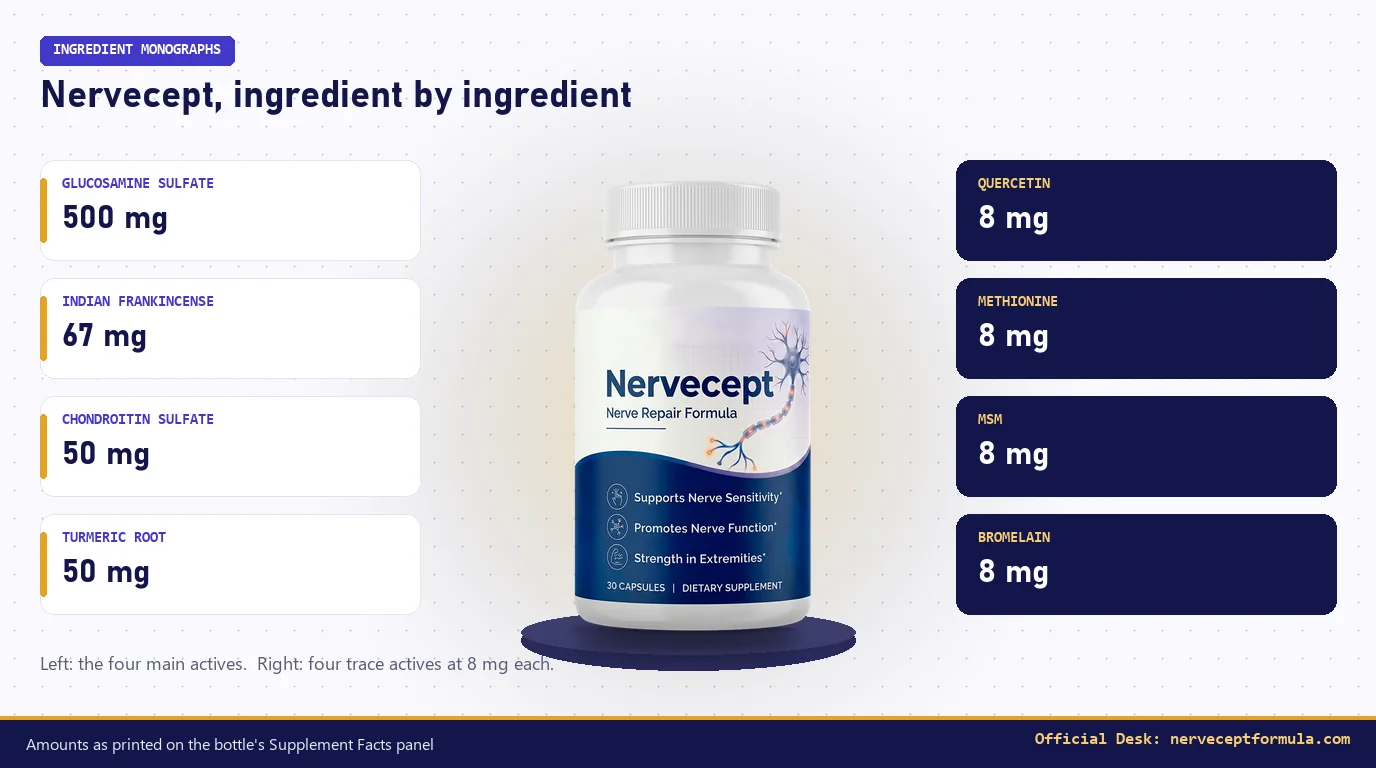
The formula in one table
Nervecept has eight active ingredients and two inactive ones. The table gives the printed amount, the plant part or chemical form, and the role each one is meant to play. Everything after the table is a monograph: what the ingredient is, what the human research found, and how the Nervecept amount compares.
| Ingredient | Per capsule | Form named on label | Intended role | Share of actives |
|---|---|---|---|---|
| Glucosamine sulfate | 500 mg | Sulfate salt, shellfish source | Connective tissue building block | 71.5% |
| Indian frankincense | 67 mg | Boswellia serrata, herb | Inflammatory signaling (5-LOX) | 9.6% |
| Chondroitin sulfate | 50 mg | Sulfate, source not stated | Cartilage water binding | 7.2% |
| Turmeric | 50 mg | Curcuma longa, root | Inflammatory signaling (NF-kB) | 7.2% |
| Quercetin | 8 mg | Sophora japonica, bud | Antioxidant flavonoid | 1.1% |
| Methionine | 8 mg | Amino acid | Sulfur donor, glutathione precursor | 1.1% |
| MSM | 8 mg | Methylsulfonylmethane | Sulfur donor | 1.1% |
| Bromelain | 8 mg | Ananas comosus, stem | Proteolytic enzymes | 1.1% |
Inactive ingredients are hypromellose, the plant-cellulose material the capsule shell is made of, and rice flour, a common filler that helps powders flow during encapsulation. The label carries the allergen statement "Contains: Shellfish (Crayfish)", which applies to the glucosamine.
Two observations frame everything below. First, this is a joint-comfort formula in structure: glucosamine, chondroitin, boswellia, turmeric, MSM and bromelain are the classic ingredients of osteoarthritis supplements. Second, the amounts are modest. The capsule format caps the total at about 700 mg, and the formula spends 500 mg of that on glucosamine, leaving small amounts for everything else.
Glucosamine sulfate, 500 mg
What it is
Glucosamine is an amino sugar. The body builds it from glucose and the amino acid glutamine, then uses it to assemble glycosaminoglycans and proteoglycans, the large molecules that give cartilage its springiness and help hold water in tendons, ligaments and the tissue around joints. Supplement manufacturers usually produce it by breaking down chitin from crustacean shells. The Nervecept label names crayfish as the shellfish source.
Supplements use two main salts: glucosamine sulfate, which Nervecept uses, and glucosamine hydrochloride. The difference matters because the strongest positive trials used a specific crystalline glucosamine sulfate preparation at 1,500 mg once a day, while several large negative trials used the hydrochloride form.
What the research found
A three-year Belgian trial gave 212 people with knee osteoarthritis either 1,500 mg of glucosamine sulfate or placebo daily and measured the joint space on X-rays. The placebo group lost more joint space, and symptoms were better in the glucosamine group[2]. That study is the high-water mark for glucosamine.
The U.S. National Institutes of Health then funded the GAIT trial, with 1,583 participants, testing glucosamine hydrochloride 1,500 mg, chondroitin 1,200 mg, both together, the painkiller celecoxib and placebo for 24 weeks. Overall, neither supplement beat placebo for pain, although a subgroup with moderate-to-severe pain did better on the combination[1]. A network meta-analysis that pooled ten large trials concluded that glucosamine, chondroitin and their combination did not produce clinically relevant reductions in joint pain[4]. A Cochrane review found that the positive results clustered around one pharmaceutical-grade preparation, with other products performing no better than placebo[3].
Absorption
Glucosamine is absorbed reasonably well from the gut. A pharmacokinetic study of crystalline glucosamine sulfate in healthy volunteers found that blood levels rose in proportion to dose across 750 to 1,875 mg and reached levels comparable to those used in lab experiments only at the 1,500 mg dose[5]. At 500 mg, Nervecept would be expected to produce correspondingly lower levels.
How Nervecept's amount compares
500 mg is one third of the research dose. It is by far the closest any Nervecept ingredient gets to studied amounts, and the formula's credibility mostly rests on it. Note that every glucosamine study above measured joint pain and cartilage, never nerve symptoms.
Indian frankincense, Boswellia serrata, 67 mg
What it is
Boswellia serrata is a tree native to India whose gum resin, called salai guggal, has been used in Ayurvedic practice for joint swelling. The resin contains boswellic acids, of which 3-O-acetyl-11-keto-beta-boswellic acid (AKBA) is considered the most active. Laboratory work shows boswellic acids inhibit 5-lipoxygenase, the enzyme that produces leukotrienes, signaling molecules involved in inflammation[10].
What the research found
In a 90-day randomized trial, people with knee osteoarthritis took 100 mg or 250 mg a day of an extract enriched to 30% AKBA, or placebo. Both doses improved pain and physical function scores compared with placebo, and the higher dose did better[8]. A 2020 meta-analysis of seven randomized trials found that boswellia and its extracts improved pain, stiffness and function in osteoarthritis, with a good safety record over the short study periods[9].
How Nervecept's amount compares
The Nervecept label calls its 67 mg the "herb", without an extract ratio or a boswellic acid percentage. Commercial raw resin powders typically contain a modest share of total boswellic acids, and much less AKBA than enriched extracts like the one trialed above. So while 67 mg sounds close to 100 mg, the active content is probably a fraction of what the trial participants received. If boswellia is a priority for you, look for products that state a standardization figure.
Chondroitin sulfate, 50 mg
What it is
Chondroitin sulfate is a long chain of repeating sugars attached to proteins in cartilage, where its negative charges pull in water and give the tissue its shock-absorbing quality. Supplement chondroitin is extracted from animal cartilage, commonly bovine, porcine, chicken or shark. The Nervecept label does not state the source, which matters for buyers who avoid particular animal products.
What the research found
A Cochrane review analyzed 43 randomized trials with nearly 10,000 participants. It concluded that chondroitin, alone or with glucosamine, may modestly improve osteoarthritis pain over the short term compared with placebo, with low-quality evidence overall, and that it was well tolerated[6]. The doses in those trials were usually 800 to 1,200 mg a day. The National Center for Complementary and Integrative Health summarizes the research on both glucosamine and chondroitin as mixed and notes that results differ by product and study quality[7].
How Nervecept's amount compares
50 mg is roughly 4% to 6% of the doses studied. Its presence on the label adds a familiar name more than a meaningful amount.
Turmeric root, Curcuma longa, 50 mg
What it is
Turmeric is the dried, ground rhizome of a ginger-family plant and the source of curcumin, the yellow pigment that carries most of its research interest. In cell and animal studies curcumin inhibits NF-kB, COX-2 and other inflammatory pathways. The label lists "Turmeric (Curcuma longa)(root)", meaning ground root rather than a concentrated curcumin extract.
What the research found
A meta-analysis of randomized trials in joint arthritis found that turmeric extracts and curcumin, typically around 1,000 mg of curcumin a day for 8 to 12 weeks, reduced pain scores compared with placebo[11]. The authors called for larger, longer trials before firm conclusions. The bigger problem is bioavailability: curcumin is poorly absorbed, rapidly metabolized and quickly eliminated[12]. In a classic study, adding 20 mg of piperine from black pepper raised curcumin blood levels about twenty-fold in human volunteers[13].
How Nervecept's amount compares
Turmeric powder is usually a few percent curcumin by weight, so 50 mg of root provides perhaps one to two milligrams of curcumin, with no piperine to help absorption. That is under 1% of the extract doses used in the trials. On the positive side, it also keeps turmeric far from the high-dose range linked to rare liver injury reports[14].
The four 8 mg ingredients: quercetin, methionine, MSM, bromelain
Quercetin (from Sophora japonica bud)
Quercetin is a flavonoid found in onions, apples, capers and the dried flower buds of the Japanese pagoda tree named on the label. It has antioxidant and anti-inflammatory activity in laboratory studies, and human trials usually give 500 to 1,000 mg a day[15]. A normal diet supplies roughly 10 to 30 mg a day, so 8 mg is about one apple's worth.
Methionine
Methionine is an essential sulfur-containing amino acid. The body uses it to start every protein chain and, through the methylation cycle, to make S-adenosylmethionine and the antioxidant glutathione. Adults eating ordinary amounts of protein take in well over a gram a day from food. There are no published trials of methionine supplements for nerve or joint symptoms, and 8 mg is nutritionally negligible.
MSM (methylsulfonylmethane)
MSM is an organic sulfur compound present in small amounts in fruit, vegetables and milk, and popular in joint products. Two randomized knee osteoarthritis trials used 6 grams a day and about 3.4 grams a day for 12 weeks, and reported modest improvements in pain and function[16][17]. Nervecept's 8 mg is several hundred times smaller than those doses.
Bromelain (from pineapple stem)
Bromelain is a mixture of protein-digesting enzymes extracted from pineapple stems. It is studied for swelling after injury or surgery and for osteoarthritis. A review of the osteoarthritis trials found inconsistent results, with most positive studies using hundreds of milligrams a day or more[18]. Because enzyme strength varies by batch, quality bromelain is usually labeled in activity units (GDU or MCU) as well as weight; the Nervecept label gives weight only.
What is not in Nervecept
A buyer comparing nerve products will notice ingredients that appear in many neuropathy formulas but not on this label. The maker's sales page shows images of vitamin B12, thiamine, biotin, spirulina and magnesium, and one FAQ answer mentions biotin. None of those are listed on the Supplement Facts panel, which is the legally binding list of contents.
| Common nerve ingredient | In Nervecept? | Why people look for it |
|---|---|---|
| Alpha-lipoic acid | No | Oral 600 mg a day reduced symptom scores in diabetic neuropathy trials[22] |
| Vitamin B12 | No | Deficiency causes neuropathy; common with metformin and age |
| Benfotiamine / thiamine (B1) | No | Used in diabetic neuropathy formulas; deficiency causes nerve damage |
| Vitamin B6 | No | Needed for nerve function, though excess B6 itself can cause neuropathy |
| Acetyl-L-carnitine | No | Studied for chemotherapy and diabetic neuropathy, with mixed results |
| Magnesium | No | Shown in the maker's images, not on the label |
This is not a criticism of the ingredients that are included, only a clear statement of what you are and are not buying. If you suspect a vitamin deficiency, a blood test is cheaper and more useful than any formula.
The allergen and interaction notes that follow from the ingredients
Shellfish. Glucosamine from crustacean shells is why the label says "Contains: Shellfish (Crayfish)". Crustacean shellfish is one of the major food allergens that U.S. law requires labels to declare[21]. The allergy is triggered by shellfish proteins, and a small study of shellfish-allergic patients found no immediate reactions to glucosamine-chondroitin[19]. Even so, the label warning is unconditional, and the decision belongs with an allergist.
Blood thinners. Case reports and FDA MedWatch submissions describe a rise in INR, the warfarin blood test, after people on warfarin started glucosamine, sometimes with bruising or bleeding[20]. Turmeric, quercetin and bromelain have also been discussed as possible contributors to bleeding risk at higher doses. Anyone on warfarin, a newer anticoagulant or antiplatelet therapy should ask before starting.
Pregnancy, nursing and children. The label excludes these groups without physician advice, which is consistent with the lack of safety research for these ingredients in those populations.
Questions on this topic
Which Nervecept ingredient matters most?
Glucosamine sulfate. It makes up 500 of the 699 mg of actives and is the only ingredient present at a meaningful fraction (one third) of the dose used in long-term trials.
Is Nervecept's boswellia standardized?
The label does not say so. It lists 67 mg of Boswellia serrata "herb" with no boswellic acid or AKBA percentage, so the active content cannot be calculated from the label.
Does Nervecept contain vitamin B12 or alpha-lipoic acid?
No. Neither appears on the Supplement Facts panel, even though B12 and other vitamins appear in images on the maker's sales page.
Is the glucosamine in Nervecept vegan?
No. The label states it contains shellfish (crayfish), the usual source of glucosamine. The capsule shell itself is plant-based hypromellose.
Can I take extra glucosamine alongside Nervecept?
Some people do, to reach the 1,500 mg used in trials. Ask your pharmacist first, particularly if you take blood thinners, and never exceed one Nervecept capsule a day, which is the label limit.
Why are four ingredients only 8 mg?
Capsule space. With 500 mg already used by glucosamine, the remaining actives share about 200 mg. At 8 mg, quercetin, methionine, MSM and bromelain are present but far below studied amounts.
Sources for this page
Each entry links to the original record. These studies test single ingredients, usually at higher doses; none tested the finished Nervecept capsule.
- 1Clegg DO, Reda DJ, Harris CL, et al. Glucosamine, chondroitin sulfate, and the two in combination for painful knee osteoarthritis. N Engl J Med. 2006;354(8):795-808. pubmed.ncbi.nlm.nih.gov/16495392/
- 2Reginster JY, Deroisy R, Rovati LC, et al. Long-term effects of glucosamine sulphate on osteoarthritis progression: a randomised, placebo-controlled clinical trial. Lancet. 2001;357(9252):251-256. pubmed.ncbi.nlm.nih.gov/11214126/
- 3Towheed TE, Maxwell L, Anastassiades TP, et al. Glucosamine therapy for treating osteoarthritis. Cochrane Database Syst Rev. 2005;(2):CD002946. pubmed.ncbi.nlm.nih.gov/15846645/
- 4Wandel S, Juni P, Tendal B, et al. Effects of glucosamine, chondroitin, or placebo in patients with osteoarthritis of hip or knee: network meta-analysis. BMJ. 2010;341:c4675. pubmed.ncbi.nlm.nih.gov/20847017/
- 5Persiani S, Roda E, Rovati LC, et al. Glucosamine oral bioavailability and plasma pharmacokinetics after increasing doses of crystalline glucosamine sulfate in man. Osteoarthritis Cartilage. 2005;13(12):1041-1049. pubmed.ncbi.nlm.nih.gov/16168682/
- 6Singh JA, Noorbaloochi S, MacDonald R, Maxwell LJ. Chondroitin for osteoarthritis. Cochrane Database Syst Rev. 2015;1:CD005614. pubmed.ncbi.nlm.nih.gov/25629804/
- 7National Center for Complementary and Integrative Health. Glucosamine and Chondroitin for Osteoarthritis. www.nccih.nih.gov/health/glucosamine-and-chondroitin-for-osteoarthritis
- 8Sengupta K, Alluri KV, Satish AR, et al. A double blind, randomized, placebo controlled study of the efficacy and safety of 5-Loxin for treatment of osteoarthritis of the knee. Arthritis Res Ther. 2008;10(4):R85. pubmed.ncbi.nlm.nih.gov/18667054/
- 9Yu G, Xiang W, Zhang T, et al. Effectiveness of Boswellia and Boswellia extract for osteoarthritis patients: a systematic review and meta-analysis. BMC Complement Med Ther. 2020;20(1):225. pubmed.ncbi.nlm.nih.gov/32680575/
- 10Siddiqui MZ. Boswellia serrata, a potential antiinflammatory agent: an overview. Indian J Pharm Sci. 2011;73(3):255-261. pubmed.ncbi.nlm.nih.gov/22457547/
- 11Daily JW, Yang M, Park S. Efficacy of turmeric extracts and curcumin for alleviating the symptoms of joint arthritis: a systematic review and meta-analysis of randomized clinical trials. J Med Food. 2016;19(8):717-729. pubmed.ncbi.nlm.nih.gov/27533649/
- 12Anand P, Kunnumakkara AB, Newman RA, Aggarwal BB. Bioavailability of curcumin: problems and promises. Mol Pharm. 2007;4(6):807-818. pubmed.ncbi.nlm.nih.gov/17999464/
- 13Shoba G, Joy D, Joseph T, et al. Influence of piperine on the pharmacokinetics of curcumin in animals and human volunteers. Planta Med. 1998;64(4):353-356. pubmed.ncbi.nlm.nih.gov/9619120/
- 14National Center for Complementary and Integrative Health. Turmeric: Usefulness and Safety. www.nccih.nih.gov/health/turmeric
- 15Li Y, Yao J, Han C, et al. Quercetin, inflammation and immunity. Nutrients. 2016;8(3):167. pubmed.ncbi.nlm.nih.gov/26999194/
- 16Kim LS, Axelrod LJ, Howard P, Buratovich N, Waters RF. Efficacy of methylsulfonylmethane (MSM) in osteoarthritis pain of the knee: a pilot clinical trial. Osteoarthritis Cartilage. 2006;14(3):286-294. pubmed.ncbi.nlm.nih.gov/16309928/
- 17Debbi EM, Agar G, Fichman G, et al. Efficacy of methylsulfonylmethane supplementation on osteoarthritis of the knee: a randomized controlled study. BMC Complement Altern Med. 2011;11:50. pubmed.ncbi.nlm.nih.gov/21708034/
- 18Brien S, Lewith G, Walker A, Hicks SM, Middleton D. Bromelain as a treatment for osteoarthritis: a review of clinical studies. Evid Based Complement Alternat Med. 2004;1(3):251-257. pubmed.ncbi.nlm.nih.gov/15841258/
- 19Gray HC, Hutcheson PS, Slavin RG. Is glucosamine safe in patients with seafood allergy? J Allergy Clin Immunol. 2004;114(2):459-460. pubmed.ncbi.nlm.nih.gov/15341031/
- 20Knudsen JF, Sokol GH. Potential glucosamine-warfarin interaction resulting in increased international normalized ratio: case report and review of the literature and MedWatch database. Pharmacotherapy. 2008;28(4):540-548. pubmed.ncbi.nlm.nih.gov/18363538/
- 21U.S. Food and Drug Administration. Food Allergies. www.fda.gov/food/food-labeling-nutrition/food-allergies
- 22Ziegler D, Ametov A, Barinov A, et al. Oral treatment with alpha-lipoic acid improves symptomatic diabetic polyneuropathy: the SYDNEY 2 trial. Diabetes Care. 2006;29(11):2365-2370. pubmed.ncbi.nlm.nih.gov/17065669/
Ready to give Nervecept a fair 60 days?
Orders complete on the maker's BuyGoods checkout. The refund policy covers opened and empty bottles if you email support within the 60-day window.